topappsreviews may earn a commission when you buy through links on this page, at no extra cost to you. This does not affect our ratings.
So, what is a pangram ai detector explained in plain terms? It is a tool that examines how automated text analysis software spots machine-like patterns in written material. Editors, academic reviewers, and publishers rely on these utilities to judge whether a submission was written by a person or produced by a generator. Picking the right option means understanding the linguistic screening logic behind it, not simply trusting marketing copy. The editorial staff at Top Apps Reviews offers clear benchmarks to make that choice easier.
Quick verdict: with an overall topappsreviews score of 7.7 out of ten, Pangram AI Detector fits content teams and academic reviewers who need structured screening of synthetic text. It is a weaker match for casual users who check the odd short passage and expect an instant, unverified pass or fail.
| Metric | Assessment |
|---|---|
| topappsreviews score | 7.7 / 10 |
| Best for | Publishers, compliance reviewers, and editorial departments managing substantial text queues |
| Not ideal for | Casual writers who need conversational editing feedback rather than linguistic origin screening |
| Key strengths | Focused synthetic pattern evaluation, document-level scoring, and targeted text verification |
| What to check before buying | Review seat provisioning, usage allowances, and submission formats on the official website |
1. How topappsreviews Reviewed Pangram AI Detector
This review covers what Pangram AI Detector is designed to do, who it serves, and how it stacks up against similar tools. We applied seven topappsreviews criteria: features, ease of use, pricing and value, integrations, audience fit, support, and competitive position. Plans, prices, and limits change frequently, so we flag what to confirm on the official website before buying. This article was researched and drafted with AI assistance, then reviewed and edited by the topappsreviews Editorial Team.
2. What Pangram AI Detector Is and Who Should Use It
Pangram AI Detector sits in the content verification and synthetic text analysis software category. Its core job is scanning text to surface statistical signals that separate machine-written drafts from human composition. Organizations turn to these screening tools when original authorship matters for compliance, academic integrity, or publishing standards.
The product is aimed at professional teams that handle written work from several contributors. Editorial managers, admissions committees, academic integrity officers, and digital agency leads make up the core audience. These evaluators need structured assessments that flag passages needing manual editorial checks before publication or grading.
Solo operators also consider text analysis utilities, but automated detectors deliver the most value inside formal review pipelines. Buyers should treat text verification as an assistive editorial step rather than a final verdict, keeping human judgment central to every review.
3. Core Features of Text Detection Software
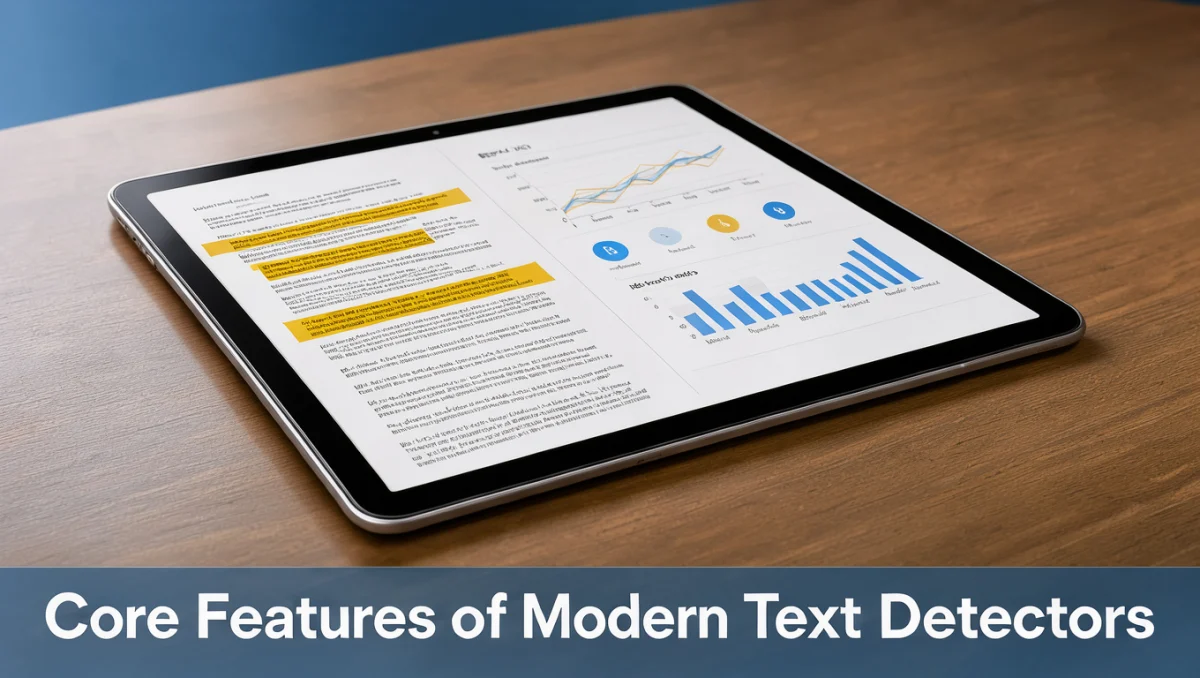
Verification platforms evaluate lexical predictability, sentence cadence, and token likelihood across entire documents. Understanding these functional pillars helps buyers judge whether a platform fits their editorial protocols.
3.1. Synthetic Pattern and Token Probability Analysis
Generative models build sentences by choosing statistically probable next words. Specialized detection utilities calculate the likelihood of token sequences across paragraphs and flag stretches where probability scores stay unnaturally uniform. Human writing shows varied vocabulary and uneven sentence lengths, while machine drafts tend toward mathematical consistency.
3.2. Document Scoring and Segment Highlighting
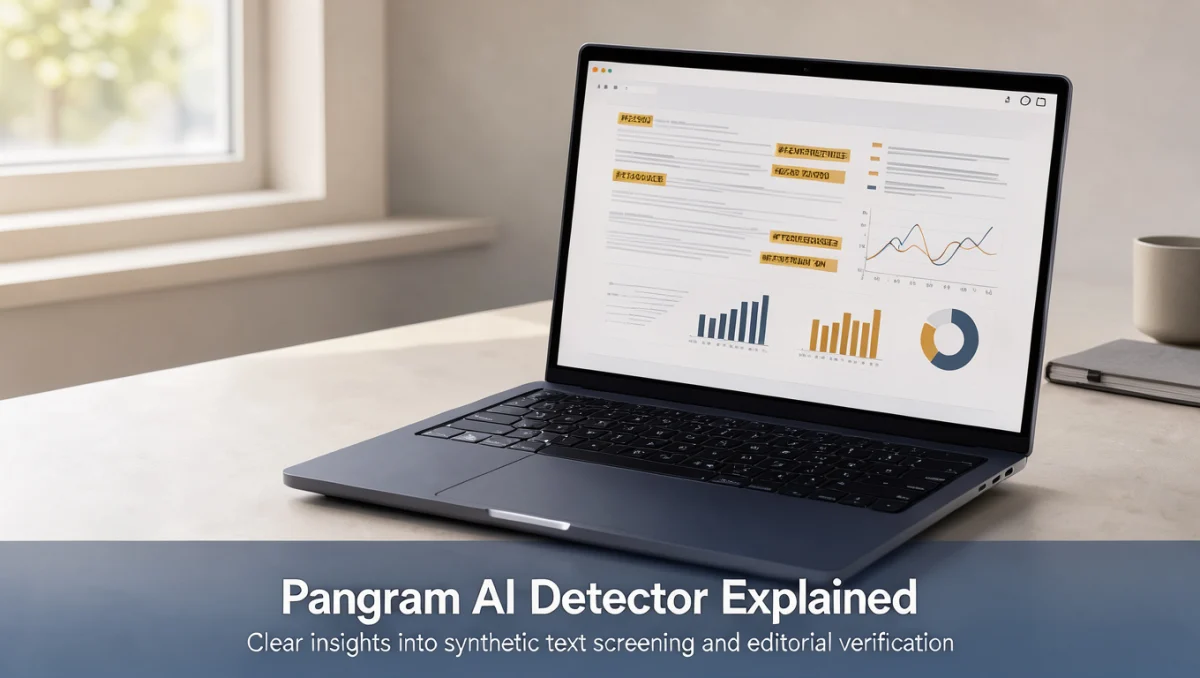
Analysis engines produce a document-level percentage summary alongside a segment-by-segment visual breakdown. Highlighted passages mark the exact sections showing high predictability. This granular view lets editors focus manual review on flagged passages instead of re-reading the whole manuscript.
3.3. Batch Processing and Queue Handling
Publishing workflows often involve many submissions at once, and copy-and-paste checks do not scale. Dedicated text analysis tools let users organize document queues, which helps during large editorial calendars or seasonal grading periods.
3.4. Exportable Compliance Reporting
Organizations frequently need documented audit trails when authorship is disputed. Reporting features compile scan summaries, timestamps, and highlighted excerpts into shareable records that editorial boards or academic committees can review together.
4. Ease of Use and Learning Curve
Pangram AI Detector offers a clean evaluation workspace that presents statistical data without drowning users in technical jargon. New team members can paste excerpts or upload documents and receive visual percentage outputs soon after opening their account dashboard.
The main learning curve is interpreting probabilistic scores correctly. Teams must understand that statistical likelihood is not proof of machine generation. Setting internal percentage thresholds and defined human review steps keeps the interface working as an editorial aid rather than a bottleneck.
5. Pros and Cons
Judging any content screening utility means weighing its analytical strengths against the constraints of the category. Buyers should assess these trade-offs before committing administrative resources.
5.1. Advantages
- Structured statistical scoring that isolates uniform syntax patterns across lengthy documents.
- Visual highlighting that points human editors straight to suspicious passages.
- Simple submission workflows suited to non-technical editorial staff.
- Clear audit summaries that support formal committee reviews and record keeping.
5.2. Limitations
- Statistical analysis cannot offer absolute certainty, so human judgment is required for final decisions.
- Heavily edited hybrid drafts can complicate origin attribution and call for secondary review.
- Subscription terms and submission volume limits need ongoing administrative oversight.
6. Pangram AI Detector vs Similar Tools

The text verification market includes several established tools. Turnitin focuses on institutional academic integrity, embedding text screening within assignment management and plagiarism repositories. Copyleaks emphasizes multi-language detection alongside web-based plagiarism comparison for corporate compliance. Winston AI tailors its reporting to web publishers, educators, and search optimization teams who want clear readability metrics. Within this field, Pangram AI Detector positions itself as a focused synthetic text screening utility built for assessing machine-generated phrasing inside professional editorial pipelines.
| Platform | Primary Positioning | Ideal Operational Context |
|---|---|---|
| Pangram AI Detector | Dedicated statistical analysis of synthetic text patterns | Editorial teams and reviewers seeking focused linguistic origin scans |
| Turnitin | Comprehensive academic integrity and assignment submission management | Secondary and higher education institutions requiring grading archives |
| Copyleaks | Enterprise compliance, code analysis, and dual plagiarism detection | Corporate legal departments and broad cross-language publishers |
| Winston AI | Publishing verification paired with readability and scanning reports | Digital agencies, bloggers, and freelance content managers |
7. Who Should Use Pangram AI Detector
Whether this verification utility fits your daily operations depends on your publication volume, risk exposure, and team structure.
7.1. Freelance Editors and Independent Writers
Independent professionals use screening software to confirm that freelance contributors follow original writing agreements before drafts reach clients. Solo operators should check on the official website whether a single-seat option matches their monthly inspection volume without excess overhead.
7.2. Small Business Content Teams
Small marketing departments producing whitepapers, articles, and product guides need a consistent voice and authentic perspective. Automated screening helps protect brand voice and keeps repetitive synthetic drafts from diluting content quality across company channels.
7.3. Academic and Institutional Reviewers
Instructors and committee members handle research papers that must reflect independent student scholarship. Automated tools help these evaluators identify passages that warrant a direct conversation with the author about research methods and draft development.
7.4. Groups That Should Consider Other Options
Casual bloggers writing personal reflections or internal memos do not need a dedicated detection subscription. Likewise, teams that need comprehensive code plagiarism repositories or deep legal contract archiving should look at broader compliance suites built for those disciplines.
8. How to Choose the Right Plan
Subscription models for text analysis utilities vary widely by throughput, concurrency, and team access. Prospective buyers should consult official vendor resources to match a plan to actual workflow demands.
| What to Check on the Official Page | Why It Matters |
|---|---|
| Document and word allocation structure | Ensures peak review cycles do not exhaust monthly allowances unexpectedly |
| Multi-user seat permissions | Determines whether editors can collaborate without sharing individual access credentials |
| Accepted file formats and batch limits | Confirms your team can process native documents directly without conversion delays |
| Report export and archiving rights | Guarantees compliance records stay accessible for historical documentation needs |
| Data handling and text retention terms | Verifies whether submitted client drafts remain confidential or are used to train future models |
9. Frequently Asked Questions
9.1. How do detection platforms tell machine writing apart from human prose?
Detection platforms analyze lexical predictability, vocabulary distribution, and structural variance across sentences. Human writers mix irregular clause structures with unexpected word pairings, while machine models produce text built on statistically expected token sequences. The software calculates these distributional patterns and reports an overall statistical likelihood.
9.2. What should an editorial team do when a document receives an elevated score?
An elevated score should trigger manual editorial review rather than automatic rejection. Reviewers should examine the highlighted passages, discuss the draft outline with the author, and check source citations directly. The software serves as an initial diagnostic flag, and final publication decisions stay with human editors.
9.3. Why do detection tools sometimes flag non-native English writing?
Non-native writers often rely on formulaic grammar structures, standard transition phrases, and conservative vocabulary learned through structured language courses. These standardized constructions can resemble the statistical predictability of machine output. Editors should apply extra care when evaluating international scholarship or translated submissions.
9.4. How should an organization budget for verification software?
Organizations should estimate monthly document volume, expected word counts, and the number of reviewer seats before choosing a tier. Teams evaluating software in the Artificial Intelligence field should also budget for staff training so that reviewers interpret probabilistic metrics responsibly across departments.
10. Final Verdict
Pangram AI Detector delivers focused linguistic pattern detection designed to help editors, educators, and content managers verify written origin. Its dedicated scoring and clear highlights, without extra interface clutter, make it a practical diagnostic addition to structured review pipelines.
| Criterion | Score / 10 | Reason |
|---|---|---|
| Features | 8.0 / 10 | Strong pattern analysis and segment highlighting |
| Ease of Use | 8.5 / 10 | Clean workspace with a short onboarding curve |
| Pricing and Value | 7.0 / 10 | Value depends heavily on submission volume |
| Integrations | 7.0 / 10 | Works best as a standalone step in review workflows |
| Audience Fit | 8.5 / 10 | Well suited to editorial and academic reviewers |
| Support | 7.0 / 10 | Adequate guidance; confirm response channels before buying |
| Competitive Position | 8.0 / 10 | Focused positioning among broader integrity suites |
Overall topappsreviews Score: 7.7 / 10
For organizations handling high submission queues, Pangram AI Detector delivers actionable diagnostic clarity. Pair automated scoring with rigorous human verification to reach balanced editorial outcomes. Readers with questions about software selection can contact our editorial team through the official contact page or connect with topappsreviews on LinkedIn.