Our team at Top Apps Reviews rarely approaches marketing software with a simple yes or no. Instead, we weigh how much structural depth a platform offers against the time, skill, and upkeep your team can realistically commit. Here, the activecampaign pros and cons reveal a tool built for sophisticated nurturing rather than quick, one-off newsletters.
Customer journey orchestration, follow-up sequences, and contact organization all sit at the center of this platform. Before investing, it helps to understand where it shines and where it demands patience from your staff.
Quick verdict: We score ActiveCampaign 8.0 out of 10. It suits teams that need multi-step branching workflows and a unified view of contacts across pipeline stages. It is less appropriate for solo operators who only send simple broadcasts with minimal setup.
| Metric | Summary Details |
|---|---|
| topappsreviews score | 8.0 out of 10 |
| Best for | Teams running multi-stage contact nurturing and structured deal tracking |
| Not ideal for | Solo senders who only distribute basic monthly broadcasts without segmentation |
| Key strengths | Visual workflow logic, lifecycle segmentation, and unified interaction histories |
| What to check before buying | Confirm seat allowances, contact tier thresholds, and feature access on the official vendor site |
How We Evaluated ActiveCampaign
We examined what ActiveCampaign is designed to accomplish, who it serves best, and how it stacks up against comparable tools. Our review weighs seven criteria: features, ease of use, pricing and value, integrations, audience fit, support, and competitive position. Pricing and plan limits change frequently, so treat our notes as a starting point and verify current details on the official website. This article was researched and drafted with AI assistance, then reviewed and edited by the Top Apps Reviews editorial team.
Quick Summary of the Trade-offs
Working with ActiveCampaign means balancing deep behavioral automation against the effort of initial setup. The platform brings email marketing, conditional automation paths, and deal tracking together in one environment.
On the positive side, you can build detailed sequences triggered by site visits, message engagement, and pipeline movement. On the other side, mastering conditional logic takes dedicated onboarding time, and your team must plan database maintenance with care.
Buyers often compare ActiveCampaign with Mailchimp, HubSpot, and Brevo. Each of these targets different priorities, from simple template-based campaigns to full lifecycle management for larger organizations.
ActiveCampaign Pros

The advantages of ActiveCampaign come from its flexible sequence design and consolidated contact data. The areas below show where the platform adds the most practical value.
Sophisticated Workflow Logic and Automation Builder
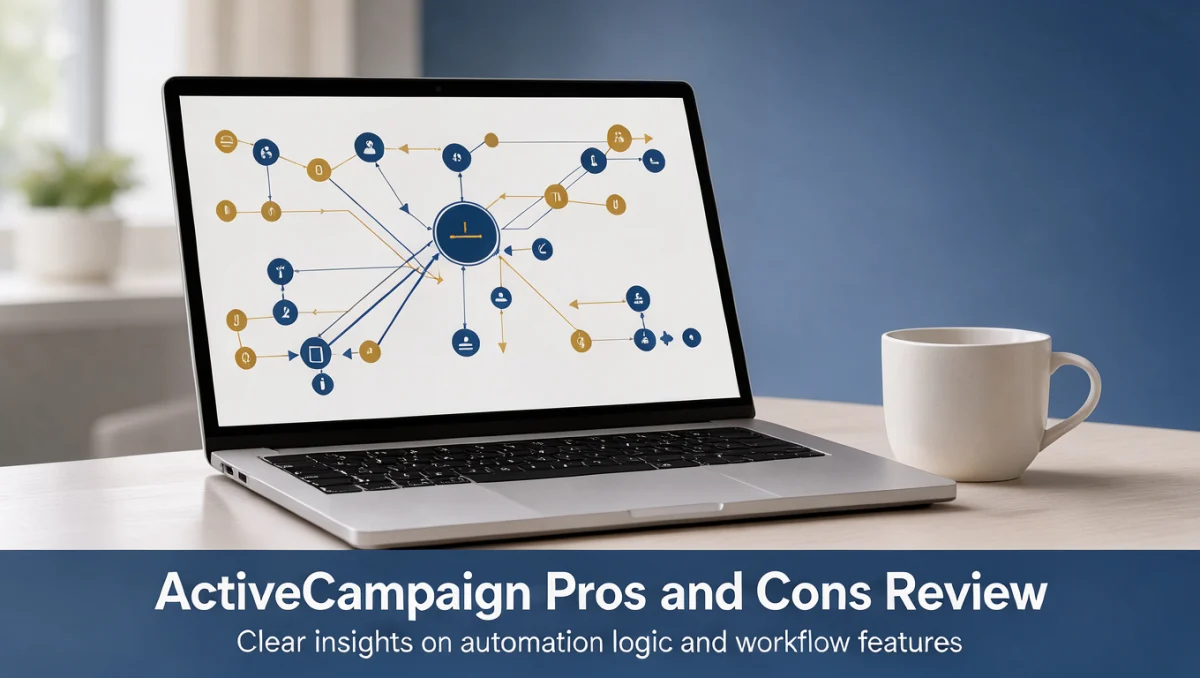
Automation is the platform's clearest strength. You can design branching journeys using multiple conditions, wait periods, goal checks, and custom webhook actions to guide contacts along tailored paths.
The visual builder maps complete customer journeys, including conditional splits, so teams can create detailed onboarding sequences without writing custom scripts. Behavioral triggers respond to contact actions, update profiles, and launch follow-up messages automatically.
Granular Audience Segmentation and Dynamic Tagging
Audience organization relies on a flexible tagging and custom field system. Tags can be applied automatically based on link clicks, page visits, and custom event markers.
This precision supports messaging that reflects each subscriber's specific interests. Dynamic content blocks can change within a single message based on segment criteria, which reduces the need to maintain duplicate campaigns for different audience groups.
Integrated Sales Pipeline Management
ActiveCampaign links marketing activity directly to deal stages. Sales staff can monitor outreach status, review communication timelines, and assign tasks across customizable pipeline stages.
Automations can advance deals or send follow-up notifications when contacts show strong buying signals. This coordination between messaging and sales tracking smooths the handoff from outreach to qualification.
Unified Contact Event History
Each contact record keeps a timeline that covers email opens, form submissions, page views, and internal notes. Team members can review this context before reaching out personally.
Keeping this history in one dashboard removes communication silos between staff. Automations can also check past behavior before deciding which message or task to trigger next.
ActiveCampaign Cons

Although the feature set offers broad flexibility, some organizational hurdles come with implementation. Recognizing these drawbacks early helps teams plan workarounds.
Steep Initial Learning Curve
The large number of triggers, actions, and conditional rules makes early setup challenging for newcomers. Building nested automations without a clear plan can produce conflicting tags and broken delivery logic.
To reduce this risk, document your tagging structure and customer journey maps on paper before building anything in the platform. Starting with simple linear automations before adding multi-branch logic helps prevent structural errors.
Complex Interface Navigation for Casual Users
The number of options across settings, campaigns, contacts, and automation menus can feel overwhelming for occasional users who only send periodic updates. Locating specific reports or segment settings may require digging through several submenus.
Teams can ease this by writing standard operating procedures for recurring tasks. Limiting administrative permissions and assigning dedicated managers to oversee campaign workflows keeps the interface manageable for general contributors.
Administrative Overhead for Database Maintenance
Tags and custom fields multiply quickly, so keeping the contact database clean requires ongoing supervision. If left unchecked, duplicate tags and redundant segments build up and complicate audience selection.
Regular database hygiene routines solve this problem. Audit active tags quarterly, archive outdated workflows, and enforce strict naming conventions for every new marketing asset.
ActiveCampaign Pros and Cons at a Glance
The table below summarizes the practical advantages and operational tradeoffs of adopting ActiveCampaign.
| Operational Category | Primary Platform Advantage | Practical Platform Limitation | Recommended Management Approach |
|---|---|---|---|
| Automation Architecture | Flexible multi-branch customer journey sequences | Complex rule sets can conflict without careful oversight | Map conditional logic on paper before building workflows |
| Data Management | Dynamic tagging and behavioral custom fields | Tag clutter builds up when tags are created without rules | Enforce strict naming conventions and audit quarterly |
| Pipeline Alignment | Connected deal stages and automated task routing | Setup requires coordination across departments | Align marketing and sales definitions before setting triggers |
| Platform Usability | Deep control over every contact touchpoint | Steep onboarding curve for non-technical staff | Create standard workflow templates for recurring campaigns |
| Reporting Visibility | Detailed interaction histories on contact records | Aggregated reporting requires familiarity with the platform | Bookmark core metric dashboards and export regular summaries |
Who Should Use ActiveCampaign
The right fit depends on your team's structure, technical readiness, and message volume. Here is how the platform serves different types of users.
Freelancers and Solo Operators
Independent professionals juggling client inquiries and product sales can use the platform to automate appointment reminders, lead qualification, and client onboarding sequences.
Freelancers who only need occasional quarterly announcements may find the setup effort outweighs their needs. Simpler newsletter services often deliver faster results for basic broadcasts.
Small Business Owners
Small business owners running dedicated client acquisition funnels gain real value from automated lead nurturing and synchronized deal pipelines. The platform keeps prospects organized without requiring separate tools for outreach and basic customer records.
Owners should make sure at least one staff member can oversee workflow rules and keep the database consistent. Without clear ownership, automated sequences can quickly become outdated.
Marketing Specialists
Marketers managing complex conversion funnels will find strong utility here. The ability to split-test automations, segment by precise behavioral signals, and personalize message elements gives the control needed for steady growth.
Campaign managers can build lead-scoring models that flag qualified accounts for immediate follow-up, which strengthens multi-channel outreach.
Office Workers and Administrative Teams
Administrative staff handling customer communications, event registrations, and notification distribution can streamline repetitive follow-up work with automated triggers.
However, internal messaging that does not involve customer nurturing or relationship tracking rarely justifies an advanced automation platform. Standard collaboration tools handle internal communication with far less setup.
Students and Educational Users
Students studying digital communications can learn core concepts of marketing automation, lifecycle segmentation, and customer relationship management through the platform.
Running a live commercial database is rarely necessary for academic study alone. Educational users should confirm whether coursework or a practice sandbox meets their goals before committing to ongoing costs.
Teams That Should Look Elsewhere
Organizations that only send occasional one-to-one notifications or basic announcements without behavioral tracking should avoid an intricate automation platform. Simpler newsletter tools will be faster to launch with minimal complexity.
Likewise, enterprises needing heavily customized database environments with specialized compliance frameworks should check whether a dedicated enterprise platform suits their scale better.
Frequently Asked Questions
What should buyers evaluate when comparing automation features?
Start by asking whether your customer communication relies on static broadcasts or dynamic, behavior-driven paths. Visual sequence builders and tagging systems pay off when prospects need multi-touch follow-up, while basic broadcast tools are enough for simple announcements.
How should an organization plan for contact database growth?
Compare your projected list growth against the tier structure on the official ActiveCampaign pricing page. Since contact tiers determine ongoing subscription costs, regularly removing disengaged addresses helps keep your database clean and your budget predictable.
When is a dedicated onboarding period necessary?
Plan for onboarding whenever your team intends to build multi-branch workflows, pipeline stage transitions, or behavioral tagging rules. Setting aside time to define naming conventions and test triggers prevents delivery errors and conflicting automation paths.
What additional costs should teams budget for?
Budget for content creation, copywriting, list verification services, and staff training time. Confirm add-on requirements, integration connectors, and specialized reporting needs on the official website to avoid surprise expenses during rollout.
Final Verdict on ActiveCampaign
Our assessment positions ActiveCampaign as a comprehensive automation and contact management engine for growth-focused organizations. As explored throughout this review, the right choice depends on balancing functional power against the effort required to implement it.
| Criterion | Score /10 | Reason |
|---|---|---|
| Features | 9.0 | Offers deep workflow logic, conditional branching, dynamic tagging, and integrated deal pipelines. |
| Ease of Use | 7.0 | Presents a noticeable learning curve and complex navigation for casual campaign creators. |
| Pricing and Value | 7.5 | Delivers solid returns for active funnels, though buyers must review tier thresholds carefully. |
| Integrations | 8.0 | Connects smoothly with common commerce, content, and form systems across standard stacks. |
| Audience Fit | 8.5 | Matches the needs of small-to-medium teams focused on systematic lifecycle nurturing. |
| Support | 7.5 | Provides documentation and direct assistance channels that buyers should confirm on the official portal. |
| Competitive Position | 8.5 | Holds a strong position against rivals like Mailchimp and HubSpot for automation-centric setups. |
Overall score: 8.0 out of 10
ActiveCampaign is a dependable choice for teams ready to invest time in structured marketing funnels, automated segmentation, and integrated deal handling. If your team only sends basic monthly updates, simpler newsletter software will serve you better. If your strategy depends on automated, behavior-driven customer journeys, ActiveCampaign gives you the architectural control to execute them well.
For help with software selection or configuring your marketing stack, contact the Top Apps Reviews team, or visit our Marketing category for more in-depth guides.